

Export an EXE File
The Windows export is the final step before distributing your desktop application on Windows devices.
You will:
- Customize the application name, icon, version, and installation behavior.
- Generate a Windows
.exeinstaller from your PandaSuite dashboard. - Share the generated file with your users, IT team, or kiosk devices.
Once the binary is generated, you can download it from your PandaSuite dashboard.
Desktop export is available on Single, Multi, Full, or Ultra plans.
What is an EXE file?
The EXE file is the executable package of your application on Windows. It lets you install your app on a Windows computer, tablet, or kiosk.
EXE files generated with PandaSuite are automatically signed with an EV (Extended Validation) Code Signing certificate, which provides stronger validation and security than a standard code signing certificate.
Prerequisites
- Desktop export is available on Single, Multi, Full, or Ultra plans.
- Your project content is finalized and published.
- Your target devices run Windows 10 or later.
- If you need a fully offline package, plan to enable Asset management (offline) during export. This option requires a Yearly or One-Time Payment plan.
Minimum OS Version and Device Compatibility
| Item | Details |
|---|---|
| Minimum supported version | Windows 10 |
| Supported devices | Windows computers, touch terminals, and kiosks |
| Binary type | Native Windows .exe installer |
| Installation | The generated file installs the app directly on the device |
Important points before distribution:
- Choose the right architecture for the target device fleet:
x64for most recent PCs,x86for older 32-bit machines, andARMfor compatible ARM-based hardware. - If you enable Asset management (offline), the installation package contains all assets. Any content update then requires exporting and reinstalling a new EXE.
- If you enable full-screen launch, some keyboard shortcuts that allow users to exit the application will be disabled.
Export the EXE file
Access the dashboard
- Log in to your PandaSuite dashboard.
- In Apps, create or select the relevant application.
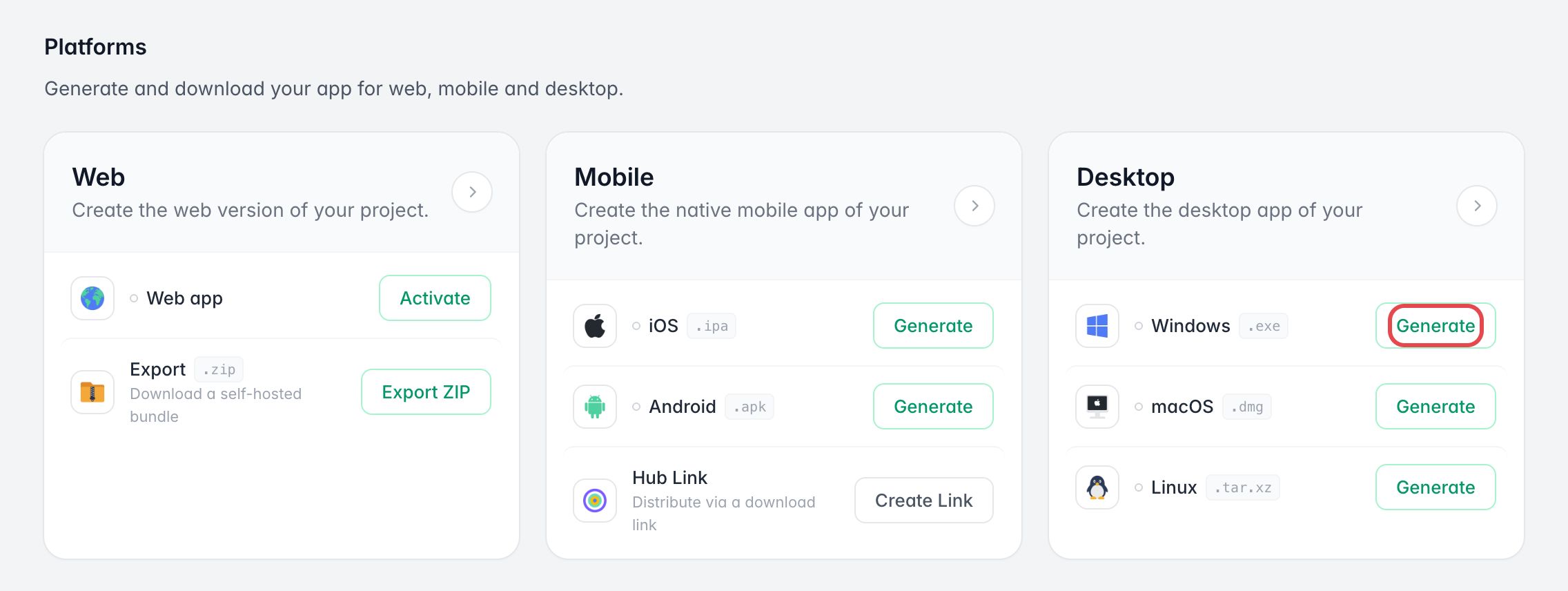
- In Platforms, find the Desktop card.
- Click Generate next to Windows.
Fill out the form
| Field | Description |
|---|---|
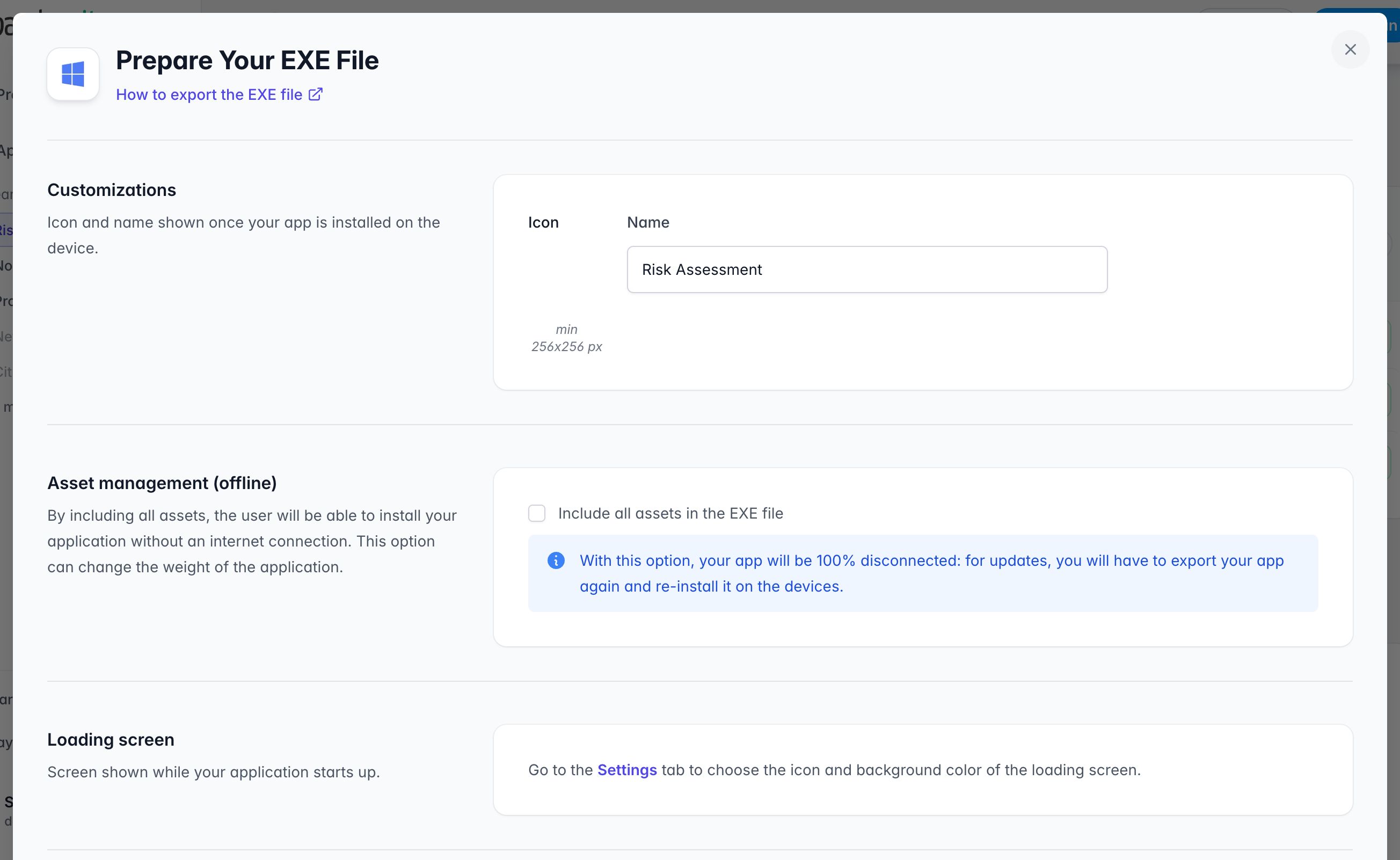
| Icon | Minimum 256 × 256 px. This is the icon Windows users will see in the installer, shortcuts, and application listings. |
| Name | The application name displayed to users on Windows. Use the final user-facing name that should appear in installation and launch contexts. |
| Asset management (offline) | Bundles all assets inside the EXE for a fully standalone offline app. This is recommended for disconnected environments, but content updates then require exporting and reinstalling a new EXE. Requires a Yearly or One-Time Payment plan. |
| Loading screen | Uses the loading screen configured in your app settings: click Settings, then choose its icon and background color in the Display tab. |
| Menu bar | Lets you show or hide the menu bar in a regular window. With full-screen launch, the Windows application may hide the menu bar. |
| Architecture | Choose between x64, x86, or ARM depending on the target devices. Selecting the wrong architecture can prevent installation on the target machine. |
| Installation method | Decide whether to install the app for all users of the device or only for the current user, depending on your rollout context. |
| Installation directory | Decide whether users can change the installation folder during setup. Keep this restricted if you want a more controlled IT deployment flow. |
| Launch method | Enables Full screen launch, meaning PandaSuite-side Kiosk Mode, for kiosks, tablets, or interactive displays. This option launches the app directly in full screen. On Windows it also adds a Kiosk admin menu, reached with keyboard shortcuts, to lock down the device: see Kiosk Mode on Windows. |
| Version / Build | We recommend starting with 1.0.0 and 1, then incrementing both with each release. The version is the visible release number, while the build tracks technical revisions. |
| Advanced options | Click Show advanced options to see or change the App ID that Windows uses to recognize the installed app: see App ID (advanced options). |
Before validating, double-check Architecture, Asset management (offline), Launch method, and Version / Build. These fields most often affect rollout and update behavior.
App ID (advanced options)
Windows recognizes your app by its App ID. A new export with the same App ID replaces the installed app and keeps its data, even if you renamed it.
To see or change it, click Show advanced options in the form. The App ID field shows the app’s current App ID: leave it empty to keep it. The EXE and the DMG each have their own App ID.
- A new app gets
com.myapp.pfollowed by its short ID. - An app created before this setting existed keeps the ID it has on computers, in the form
com.electron.<name>. If it was never exported as an EXE, its first export gets that ID too, from the app name. - A chosen App ID uses letters, numbers, hyphens and dots, with at least two segments, like
com.example.myapp(128 characters at most). The first segment starts with a letter, and each segment starts and ends with a letter or a number. The prefixcom.pandasuite.and the valueyour.idare reserved. An ID starting withcom.electron.is accepted only if a successful EXE export of this app already used it. - If you change the App ID, your next export installs as a new app, without the previous one’s data. Uninstall the previous version on each computer before installing the new one. Before exporting, Back to the current App ID cancels the change. Later, you can go back by entering a previous App ID again: any App ID that a successful EXE export of this app already used is accepted.
After a rename, desktop links to the app open once the new version has been launched. The default installer launches the app when it finishes. With Allow to change installation directory, the links wait for the first launch if the launch box is unticked on the last page, as after a silent installation. This installer also puts the app in a subfolder named after the new name: the app works and keeps its data.
Start the generation
Click Export.
The process takes place on our servers and can last from a few minutes to several hours depending on the load.
You will receive:
- A confirmation email;
- The download link on the Desktop card of your app page.
If you don’t receive the email, check your spam folder or visit the Desktop card of your app page to check the generation status. Contact support if the issue persists.
To install the generated file on a Windows device, follow Install your EXE File. For large-scale rollouts, see Silent installation of your EXE. For a locked-down experience, see Kiosk mode for Windows.
FAQ
Which architecture should I choose?
Choose x64 for most modern Windows devices, x86 for older 32-bit machines, and ARM only for compatible ARM-based devices.
Can my Windows app work fully offline?
Yes, with Asset management (offline), which embeds the published project in the EXE. External websites, streamed media, and remote data still need the network: see Standalone EXE for offline installation. Content updates then require exporting and reinstalling a new EXE.
Do I need to export a new EXE after a code or feature update?
Yes. Any code-level update requires generating a new desktop binary and reinstalling it on the target devices.
Where can I find old Windows builds?
On the Desktop card of your app page, open the options (⋮) of the Windows export and click View archives to download the versions previously generated for your app.